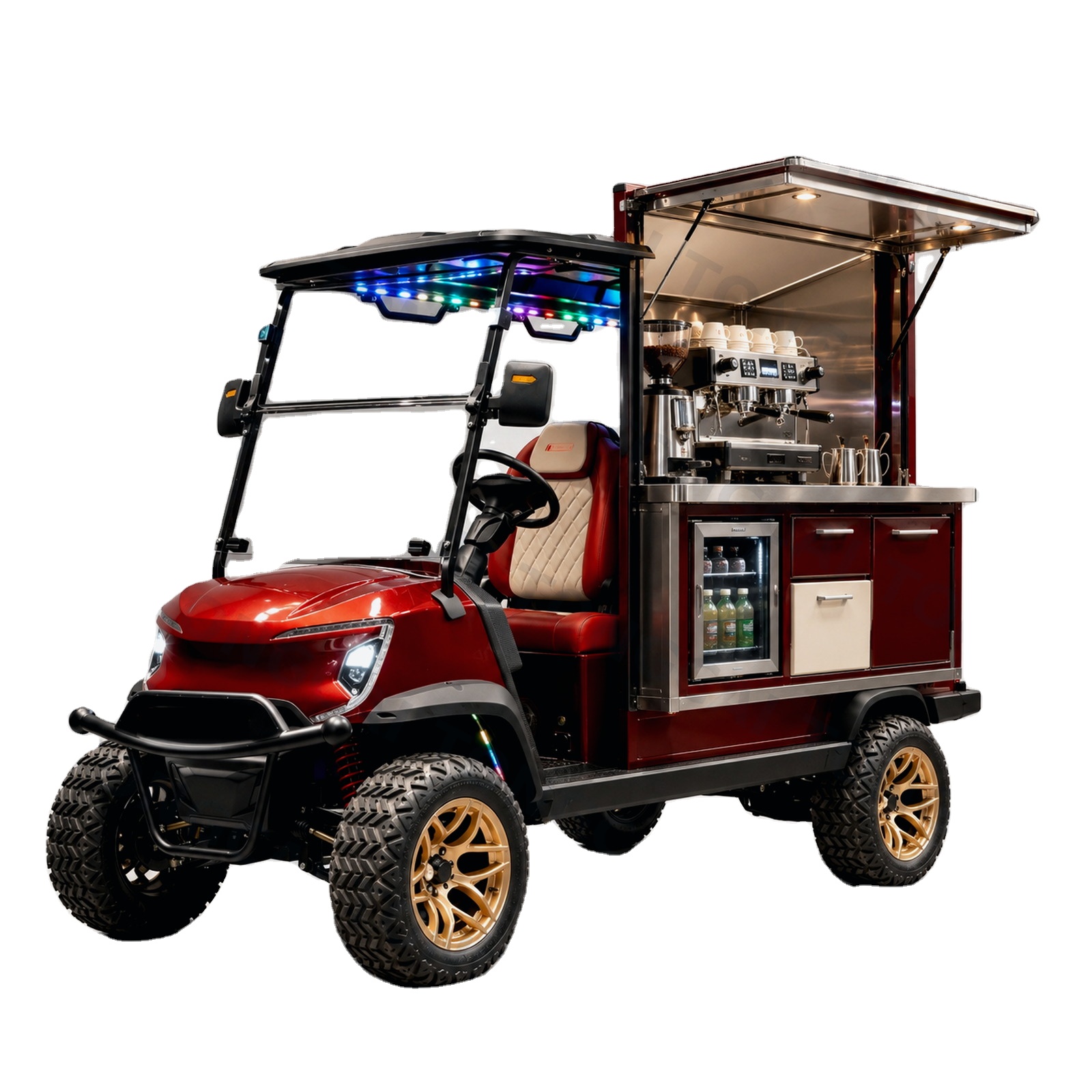
Industrial Strategic Notice: Sourcing low-speed electric vehicles (LSEVs), high-occupancy resort shuttles, electric patrol vehicles, and commercial mobile vending units from Chinese manufacturers requires structural scrutiny beyond brochure pricing. Genuine Original Equipment Manufacturers (OEMs) operate internal pipe bending, structural robotic welding, cathodic electrodeposition coating, and dedicated end-of-line dynamometer road testing rather than secondary assembly kits.
Strategic Procurement Architecture: Evaluating China's Tourist Sightseeing Vehicle Ecosystem
The global tourism and micro-mobility hospitality sectors are undergoing an irreversible shift toward zero-emission electrified transportation. Operators of 5-star eco-resorts, sprawling amusement parks, historical nature reserves, industrial production campuses, and international airport terminals demand low-speed vehicles that deliver continuous daily duty cycles without unexpected mechanical downtime. Within this landscape, Shandong CCB New Energy Machinery Co., Ltd. (operating under brand engineering Tongcai) has emerged as a premier engineering and manufacturing benchmark based in Dezhou, Shandong Province.
Procuring tourist sightseeing vehicles directly from tier-1 Chinese manufacturers grants international fleet directors undeniable financial and customization advantages. However, the operational success of an imported commercial fleet hinges on identifying manufacturers that enforce rigorous metallurgical standards, advanced battery thermal safety architectures, automotive-grade controller calibrations, and comprehensive spare-parts logistics.
1. Structural Metallurgy and Chassis Integrity: The Foundation of Commercial Longevity
Commercial sightseeing buses and golf carts operate under high dynamic stress: continuous hill climbing, heavy passenger payload cycles, humid coastal atmospheres, and frequent start-stop braking. Inferior suppliers often utilize cold-rolled commercial-grade steel frames coated merely with superficial air-dried paint, precipitating structural corrosion and weld fatigue within 18 to 24 months of tropical or maritime deployment.
High-reliability manufacturers employ reinforced robotic-welded carbon steel or aerospace-grade heat-treated 6061-T6 aluminum alloy tubular chassis. The structural sections undergo multi-stage surface preparation, including ultrasonic degreasing, zinc phosphating, and electrophoretic deposition (EPD/E-coating), followed by a thick electrostatic powder coat finish. This dual-layer surface treatment yields a salt-spray resistance exceeding 1,000 hours, rendering vehicles capable of operating indefinitely along beachfront resort promenades and humid equatorial regions without chassis degradation.
Robotic MIG/TIG Frame Assembly
Integrated jig-welded tubular space-frames eliminate chassis distortion, ensuring precise wheel alignment, reduced tire tread scrubbing, and exceptional torsion stiffness under uneven road loading.
High-Torque PMSM Drivetrains
Transition from brushed DC to Permanent Magnet Synchronous Motors (PMSM) controlled via CAN-bus automotive microcontrollers, yielding up to 92% electrical-to-mechanical conversion efficiency.
Integrated LiFePO4 Smart BMS
Dedicated cell voltage balancing, over-temperature cutoff, short-circuit containment, and remote telemetry tracking, delivering over 3,500 full charge cycles at 80% DOD.
2. Technical Powertrain Architecture: 48V, 60V, and 72V Comparative Analysis
Selecting the optimal operating voltage is the most critical technical parameter when specifying a tourist sightseeing bus or utility cart fleet. While 48V architectures represent an economical baseline for light-duty, flat-fairway golf applications, commercial passenger transport carrying 6 to 14 passengers demands higher operating voltages to minimize current draw, eliminate resistive thermal losses, and conquer steep gradients without motor thermal throttling.
| Drivetrain Platform |
Motor Topology & Rating |
Peak Torque & Climbing Grade |
Recommended Operating Environment |
TCO & Service Cycle Life |
| 48V LiFePO4 / Lead-Acid |
3.0kW – 4.0kW AC Induction |
65 Nm · ≤ 20% Gradeability |
Flat private fairways, light gated communities, mini retail carts |
Low initial capital; ideal for seasonal resort usage (3-5 years) |
| 60V High-Capacity Lithium |
4.0kW – 5.0kW Brushless PMSM |
95 Nm · ≤ 25% Gradeability |
Standard scenic park passenger shuttles, campus patrol, mobile bakeries |
Optimal balance of energy density, charging speed, and long-range utility |
| 72V High-Output 4WD System |
5.0kW – 7.5kW Permanent Magnet |
140+ Nm · ≤ 30% Gradeability |
Mountainous eco-resorts, heavy utility task hauling, off-road rough terrain |
Maximum commercial duty cycle; 3,500+ deep cycles, negligible thermal loss |
3. Future Procurement Trends Shaping the Low-Speed Vehicle Industry (2025–2030)
Global procurement executives no longer evaluate low-speed vehicles solely on purchase acquisition price. Total Cost of Ownership (TCO), fleet management automation, and multi-functional chassis modularity now steer capital expenditure allocations.
Modular Utility Platforms
Rather than buying single-purpose vehicles, operators specify swappable rear platforms: transitioning seamlessly between 8-passenger shuttle configurations, cargo flatbeds, luggage carriers, and mobile food vending enclosures.
Photovoltaic Auxiliary Roofs
Integrated monocrystalline solar roof panels feeding smart MPPT charge controllers provide continuous trickle charging, extending daily operational range by 15-25 km under direct sunlight while reducing grid recharge frequency.
Fleet Telematics & Geofencing
Modern commercial sightseeing shuttles incorporate 4G IoT telematics modules directly wired into the CAN-bus. Fleet supervisors track live GPS locations, enforce speed limits via geo-fencing, and monitor battery cell health remotely.
Lithium Iron Phosphate Standard
Lead-acid batteries are obsolete for commercial fleets due to acid spills, heavy weight, and rapid degradation. LiFePO4 has become the strict standard, reducing vehicle curb weight by up to 180 kg and doubling operational acceleration.
4. The 12-Stage Manufacturing & Quality Control Protocol at Shandong CCB / Tongcai
Quality reliability in commercial electric transport cannot be inspected into a vehicle at the final stage—it must be systematically manufactured into the structural DNA of every component. Operating out of an expansive 14,200 square meter standardized production facility in Tianqu Industrial Park, Dezhou, Shandong CCB New Energy Machinery Co., Ltd. executes a comprehensive, 12-stage internal production protocol verified on-site by TÜV Rheinland:
Stage 01 to 04: Raw Metal Fabrication & Forming
High-precision laser cutting machines slice seamless structural steel pipes and chassis plates according to CAD parametric drawings. CNC pipe bending units curve roof supports, roll bars, and structural bumpers with millimeter accuracy, avoiding micro-cracking at stress radii. Robotic and experienced manual welders assemble the chassis frame on precision clamping fixtures, followed by rigorous seam grinding and weld slag polishing.
Stage 05 to 08: Pretreatment, Coating & Mechanical Sub-Assembly
Frames enter multi-chamber pretreatment immersion tanks before receiving anti-corrosive electrostatic coatings. On Assembly Line I, heavy mechanical sub-systems are integrated: independent McPherson or double A-arm front suspensions, leaf-spring rear transaxles with integrated differential gearboxes, hydraulic dual-circuit disc brakes, and electronic power steering (EPS) columns.
Stage 09 to 12: Electrical Integration, Skinning & FQC Road Testing
Automotive-grade flame-retardant wiring harnesses, high-efficiency motor controllers, and LiFePO4 battery modules are docked. Precision thermoformed PP or fiberglass-reinforced body panels, marine-grade UV-resistant vinyl seating, and tempered split windshields are mounted. Every completed vehicle enters the Final Quality Control (FQC) track, undergoing steep ramp hill-holding tests, high-speed slalom brake trials, rain-shower water-tightness tests, and electrical isolation verification before export packaging.
100% End-of-Line Dynamometer Bench
Each transaxle and motor assembly is spun under simulated full passenger load to verify motor decibel ratings, gearbox tooth meshing tolerances, and regenerative braking torque response.
Optical Frame Geometry Audits
Chassis undergo multi-point laser dimensional inspection to ensure zero chassis dog-tracking, guaranteeing completely straight tracking and balanced tire contact patches across all four wheels.
Reinforced Export Knock-Down (SKD/CKD)
Engineered steel-cage crating protects exterior finishes during multi-week ocean transport while maximizing container cubic utilization to slash international freight overhead.
5. Custom Commercial Transformation: The Rise of Electric Mobile Vending & Hospitality Fleets
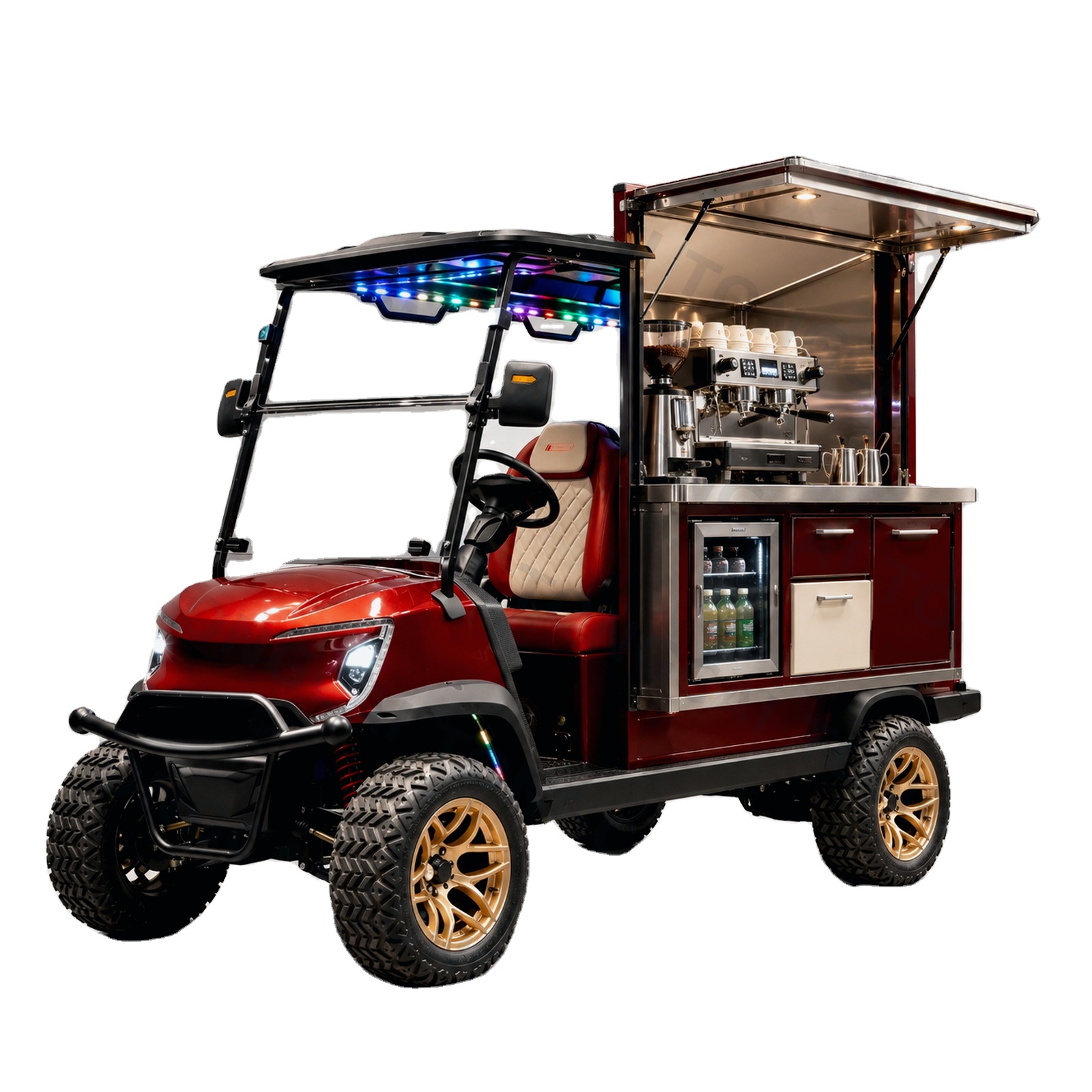
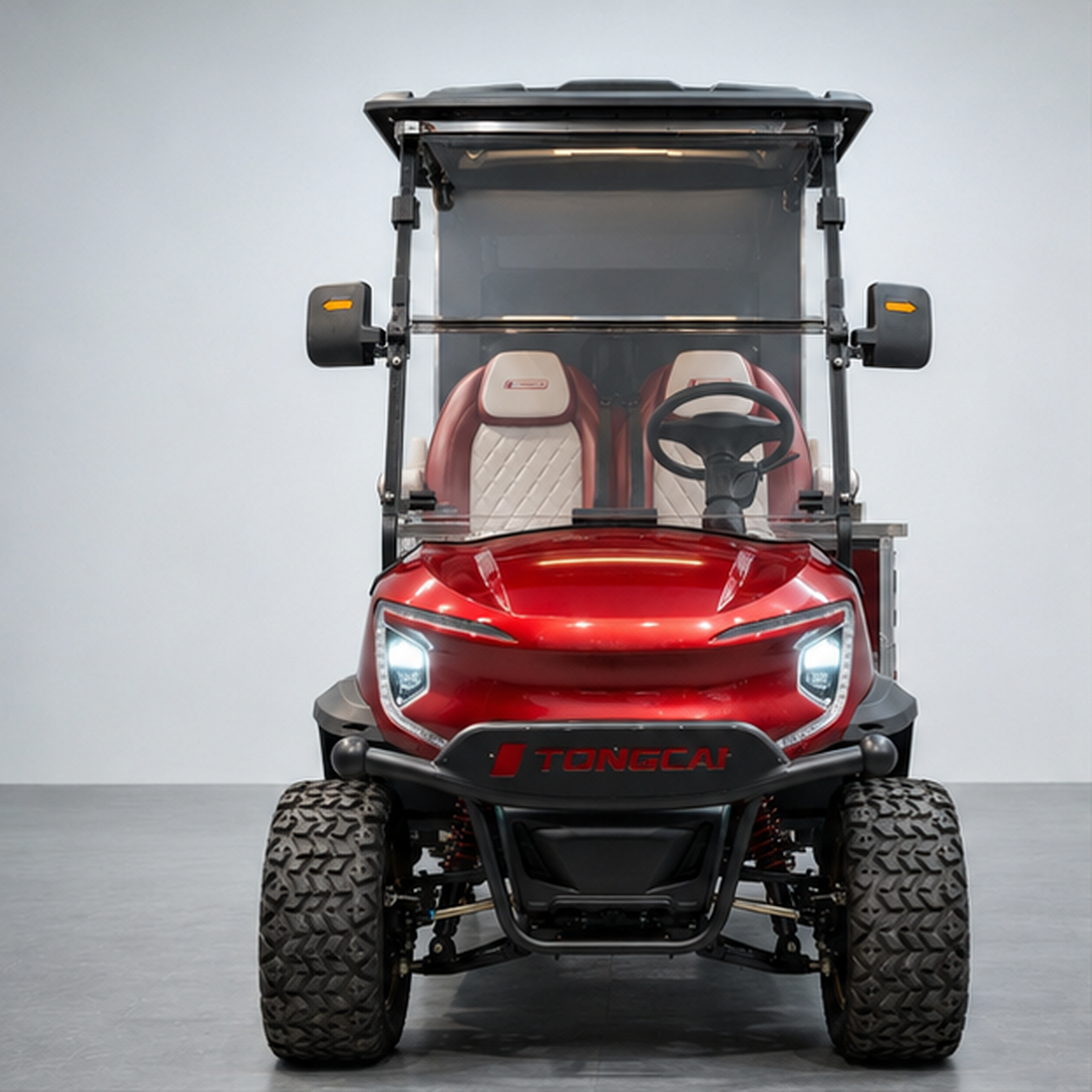
A notable procurement trend in scenic destinations, luxury resorts, theme parks, and pedestrianized urban shopping precincts is the convergence of passenger transport with mobile culinary vending. Commercial operators increasingly leverage our custom electric bakery carts, dessert trucks, and mobile beverage vehicles (such as the TONGCAI custom series showcased above). Built upon reinforced commercial golf cart and low-speed vehicle chassis, these mobile vending units incorporate dual electrical systems: a 48V/60V/72V traction battery for quiet, emission-free vehicle movement, alongside isolated auxiliary lithium battery packs powering commercial espresso machines, convection bake ovens, stainless refrigeration drawers, and ambient LED merchandising showcases.
By purchasing factory-direct from an authentic manufacturer with comprehensive custom sheet metal forming, fiberglass modeling, and specialized refrigeration wiring capabilities, buyers eliminate third-party conversion markups and gain integrated vehicles fully certified under CE low-voltage safety directives.
6. Manufacturer Competitive Edge: Shandong CCB New Energy Machinery Co., Ltd.
When selecting a Chinese manufacturing partner, supplier credibility and supply chain transparency take precedence. Shandong CCB stands apart from generic trading intermediaries through substantial physical capital investment and verified manufacturing credentials:
- On-Site TÜV Rheinland Verified: Independent European third-party audit verification confirming factory premises, production machinery, staff headcounts, and manufacturing capability.
- Genuine 14,200 m² Manufacturing Facility: Dedicated workshops for structural pipe bending, laser profiling, welding, surface spraying, final assembly lines, and finished vehicle warehousing in Dezhou, Shandong.
- Over 140 Audited Tier-1 Component Partners: Standardized procurement partnerships with leading motor manufacturers, Enpower/Curtis controller sources, and CATL/EVE battery cell channels ensuring global component traceability.
- Flexible OEM/ODM Customization: Minimum Order Quantities (MOQ) starting from just 1 unit for prototype validation, with scalable production capacity executing multi-container commercial fleet rollouts within 20 to 30 days.
- Direct Dedicated Export Engineering Desks: Multilingual technical support desks handling golf carts, all-terrain UTV/ATVs, and passenger sightseeing buses with detailed wiring diagrams and rapid air-shipped spare parts delivery.
 Deutsch
 Português
 Español
 Français
 Italiano
 Русский
 한국어
 日本語
 العربية
 ไทย
 Tiếng Việt
 Türkçe
 Nederlands
 Indonesia
 עברית
 हिन्दी